




International trade across Asia means that goods have to pass through more points in the supply chain, from factories and warehouses to ports and distribution centers in the destination country. In this situation, using pallets with consistent specifications can help companies manage handling and distribution processes in a more structured way.
One of the pallet standards used in international logistics networks is EPAL. Although it was developed from the European pallet system, EPAL can also be found in trade activities connecting Asian companies with international markets.
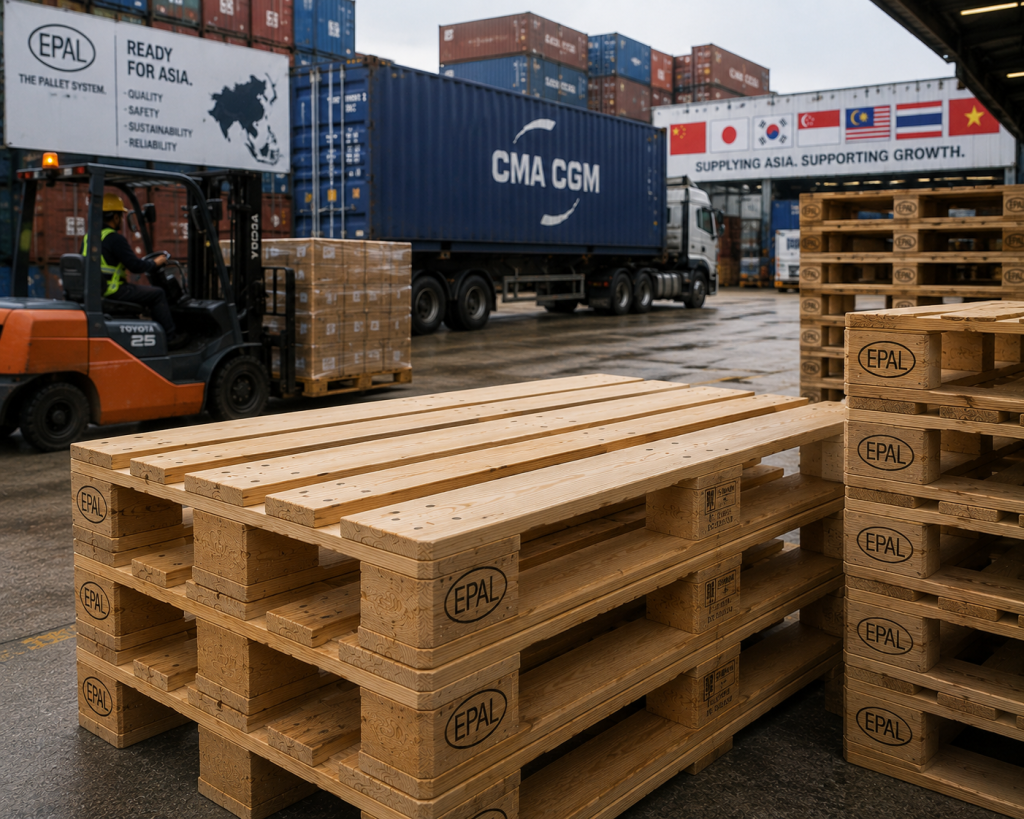
However, using EPAL for export needs to Asia does not mean that one type of pallet will automatically be suitable for every country. Each market has its own logistics systems, handling facilities, customer requirements, and import regulations that need to be considered before making a choice.
Read Also: What Is an EPAL Pallet?
How the EPAL Standard Has Developed in the Asian Market
EPAL was originally developed as a pallet exchange system in Europe. As international trade increased, the need for pallets with consistent specifications also became more relevant for companies making cross-border shipments.
According to EPAL, more than 650 million Euro Pallets are in circulation worldwide. This shows that the use of EPAL pallets has expanded far beyond its original market and has become part of the international logistics network.
Trade between Asia and Europe is one of the contexts that makes international pallet standards increasingly relevant. When goods move from a manufacturer in one country to a customer or distribution center in another, consistent pallet dimensions can help reduce the need for adjustments during the handling process.
For Asian buyers, pallet specifications are also an aspect that needs to be understood when working with suppliers or customers from countries using different standards. A pallet that fits the system in one country may not necessarily be the most efficient choice for the distribution network in another country.
Therefore, the development of EPAL use in Asia should not be seen as a replacement for all local pallet standards. EPAL is better viewed as one standard option that can be used when it fits the needs of the supply chain and business partners.
Asian Countries Where EPAL Use Is Relevant
Singapore as a Regional Logistics Hub
Singapore has a strategic position in Southeast Asian trade and logistics. Its port and distribution activities connect the country to various regional and international trade routes.
In this context, EPAL can be one pallet option for companies that need standardized specifications for cross-border shipments. However, its use still needs to be adjusted to the requirements of importers, warehouses, and logistics providers handling the goods.
This becomes even more important if goods shipped to Singapore may be distributed to other countries. The pallet used from the beginning should consider the needs of the next distribution network to avoid unnecessary pallet replacement.
Japan with Strict Import Standards
Japan has a well-structured logistics system and import regulations, so exporters need to pay attention to various requirements before shipping products to this market. For wood packaging materials, phytosanitary requirements are one of the aspects that need to be checked.
EPAL can be used if its specifications and condition meet the shipment requirements. However, EPAL status does not replace the import or phytosanitary requirements set by the destination country.
In other words, exporters need to distinguish between pallet standards and export requirements. A pallet may meet a certain standard, but the shipment must still follow the regulations applicable in the destination country.
Read Also: Wooden Pallets for Export to Japan
Other ASEAN Countries with High Trade Activity
Besides Singapore, countries such as Malaysia, Thailand, Vietnam, and Indonesia have high levels of manufacturing and international trade activity. This creates diverse pallet needs, ranging from pallets for domestic distribution to pallets for cross-border shipments.
EPAL can be an option when companies need pallets with consistent dimensions and specifications. However, the level of use and pallet requirements can vary by country and industry.
Therefore, exporters who want to use EPAL in several Asian countries should evaluate each market individually. A strategy that works effectively in Singapore may not provide the same level of efficiency when applied in Malaysia or Japan.
Why EPAL Is Relevant to Export Strategies in Asia
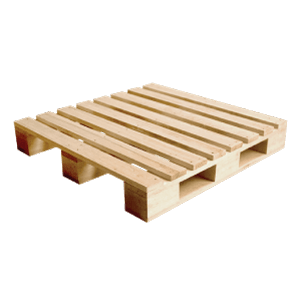
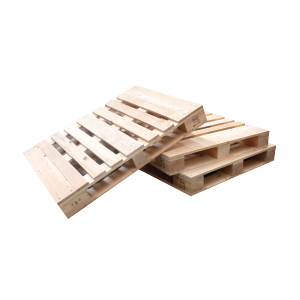
One of the main advantages of EPAL is its standardized specifications. Euro Pallet EPAL has dimensions of 800 × 1,200 mm, allowing companies to use these dimensions as a basis for planning unit loads, storage, and handling processes.
Consistent dimensions can be an advantage when companies ship to several countries that use compatible handling systems. Companies do not need to make new calculations for every pallet as long as the facilities and requirements of the receiving party support the same dimensions.
EPAL also has a reusable and exchange system that can provide benefits within certain distribution networks. When pallets can be returned or exchanged within a supporting system, companies can reduce their dependence on single-use pallets.
However, these benefits depend on the supply chain system being used. If the pallet does not return to the sender or there is no exchange network in the destination country, the benefits of a reusable system may not be fully utilized.
Standardization can also help improve communication with business partners. When buyers, suppliers, and logistics providers understand the same pallet specifications, the risk of differences in interpretation regarding dimensions and construction can be reduced.
Even so, exporters still need to make sure that the pallets used are suitable for the shipment requirements. An international standard does not mean that all warehouses and distributors in Asia use the same configuration.
Read Also: EPAL Pallet Specifications in Malaysia
Challenges of Using EPAL in the Asian Market
The first challenge is differences in regulations between countries. Each country has its own import requirements, including requirements related to wood packaging materials.
For wooden pallets used in international trade, ISPM 15 requirements are one of the aspects that need to be considered. Appropriate treatment and marking are required for conditions covered by the standard.
This means that using EPAL does not automatically mean that all export requirements have been fulfilled. Exporters still need to check the latest requirements of the destination country before the shipment is made.
Another challenge is differences in logistics infrastructure. Not all warehouses in Asia use the same specifications for racking systems, conveyors, forklifts, or handling equipment.
A pallet that works well for one distribution center may not provide the same efficiency at another facility. Therefore, pallet dimensions should be confirmed with the receiving party before the company makes a large-volume purchase.
In addition, buyers also need to pay attention to the pallet verification process. A pallet measuring 800 × 1,200 mm is not automatically an official EPAL pallet, so the product source, marking, and supplier status need to be checked.
Strategies for Choosing an EPAL Supplier for Export Needs to Asia
For multi-country export needs, pallet suppliers should be evaluated based on more than just the price per unit. Consistent quality, production capacity, export experience, and an understanding of international pallet requirements should also be part of the evaluation.
First, choose a supplier with experience in handling export requirements. This experience can help when a company needs consistent pallet specifications for different shipments and destination countries.
Second, consider the supplier’s production capacity. If the company needs pallets in large volumes on a regular basis, the supplier’s ability to maintain quality and specifications across production batches is an important factor.
Third, make sure the supplier’s certification status and compliance can be verified. For EPAL requirements, do not rely only on terms such as “Euro Pallet” or the 800 × 1,200 mm dimensions, as pallets with these dimensions are not necessarily official EPAL pallets.
Fourth, communicate the destination country from the beginning. A supplier who understands export requirements can help buyers determine suitable pallet specifications, although verification of the destination country’s regulations still needs to be carried out by the exporter and relevant parties.
Understand the Characteristics of Each Country, Not Just the Region
EPAL can be a relevant option for companies exporting to Asia, especially when their supply chain requires consistent pallet dimensions that can be used within an international logistics network.
However, Asia is not one market with one pallet standard. Each country has different logistics characteristics, infrastructure, importer requirements, and regulations.
Therefore, the better question is not simply “Is EPAL used in Asia?”, but rather “Is EPAL suitable for the supply chain and customer requirements in the destination country?”
This approach helps exporters avoid making decisions based on the assumption that one type of pallet can be used across all markets. Evaluating the destination country, product, handling method, and distribution pattern will lead to a more suitable decision.
For companies planning export strategies across several Asian countries, pallet selection should be considered from the early stages of supply chain planning. With a supplier that can maintain consistent specifications and understands the requirements of each market, EPAL can become part of a more structured regional logistics strategy.
BMR can help discuss your EPAL pallet requirements for exports to various Asian markets based on your product characteristics, load weight, handling methods, and shipping destination.
E-mail: info@bmr-pallets.com
WA: +62 8119-787-911

