




When people hear the term “paper pallet,” many immediately imagine a lightweight material that is only suitable for low-load goods. This assumption is not entirely accurate, as a pallet’s load-bearing capacity is determined not only by its base material, but also by its structural design, construction, load distribution, and conditions of use.
Therefore, the more relevant question is not simply, “How strong is a paper pallet?” but rather, “What is the load capacity of a paper pallet under specific conditions of use?” This is important for buyers who need lightweight packaging solutions while still meeting operational requirements.
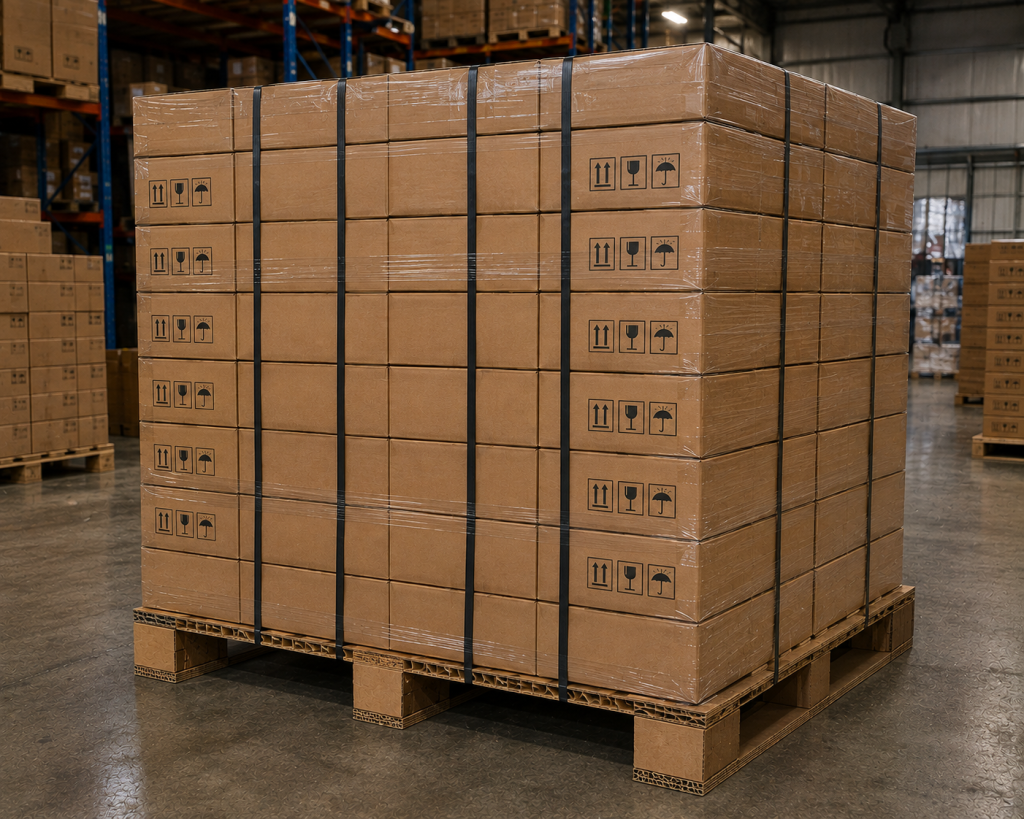
Also read “Paper Pallets for the Manufacturing Industry”
Common Misconception: Paper Pallets Are Not Strong Enough for Heavy Loads
Paper pallets do have different material characteristics compared to wooden pallets. However, differences in material do not automatically mean that their load capacity is always low.
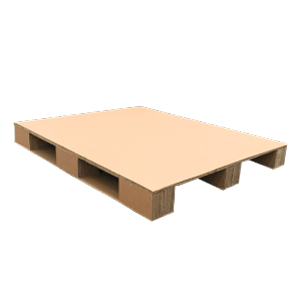
With certain construction methods, paper materials can be engineered into structures capable of providing the strength and load distribution required for industrial applications. Designs such as honeycomb, reinforced paperboard, and multi-layer configurations allow the mechanical characteristics of pallets to be adjusted to their intended applications.
One factor that is often overlooked is that pallet capacity is not solely determined by the material. Two pallets made from the same material can have different load-bearing capacities due to differences in design, dimensions, component thickness, number of supports, and how the load is positioned.
This is why paper pallets should not automatically be categorized as pallets for lightweight goods. What needs to be evaluated is the pallet specification and its actual conditions of use.
What Determines the Load Capacity of Paper Pallets
Types and Thickness of Paper Materials Used
Not all paper materials have the same characteristics. The type of paperboard, fiber structure, basis weight, thickness, and material quality can affect the strength of pallet components.
Thickness also needs to be considered together with the overall construction. Thicker material does not necessarily produce a stronger pallet if the design and load distribution are not properly engineered.
For high-load applications, suppliers should be able to explain the materials used and how those materials are combined within the pallet structure.
Structural Design
Design is one of the main factors determining the ability of a paper pallet to support a load. Single-wall, double-wall, and honeycomb structures have different characteristics in terms of distributing pressure.
Honeycomb structures, for example, use cells resembling a honeycomb to achieve a good strength-to-weight ratio. Meanwhile, multi-layer configurations can be used when higher strength and rigidity are required.
However, there is no single design that is automatically the strongest for every application. Pallet dimensions, support positions, deck size, and load patterns must be analyzed as a whole.
Lamination and Additional Reinforcement
For certain applications, paper components can be reinforced through lamination or by combining multiple layers of material. The purpose is to increase rigidity and ensure that the structure performs according to the required specifications.
Reinforcement can also be added to areas that receive greater loads. With this approach, the pallet design can be adjusted to the load distribution without making the entire construction unnecessarily heavy.
Therefore, when evaluating a high-load-capacity paper pallet, buyers should ask for information about its construction rather than focusing only on the name of the material used.
Load Capacity Range of High-Capacity Paper Pallets
It is not appropriate to assign a single load-capacity figure to all paper pallets. Capacity depends heavily on the design and testing conditions, so any capacity figure provided by a supplier should always be considered together with its intended conditions of use.
One of the most important distinctions is between static, dynamic, and racking loads.
Static load refers to a condition in which the pallet carries a load while remaining stationary, such as when goods are stored on the floor. Dynamic load refers to situations where the pallet is moved using a forklift or pallet truck, while racking refers to conditions in which the pallet is stored on a rack with specific support points.
These three conditions place different levels of stress on the pallet structure. A pallet that can support a certain load while stationary on the floor may not have the same capacity when being moved or placed on a rack.
Therefore, a figure such as “1,000 kg capacity” is not sufficient to determine whether a pallet is suitable for a particular application. Buyers need to know: 1,000 kg under what conditions, with what load distribution, and using what handling method?
Comparison with Wooden Pallet Capacity
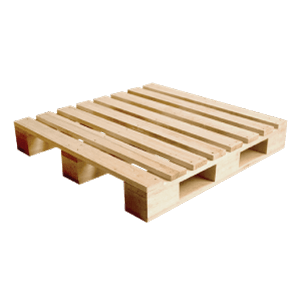
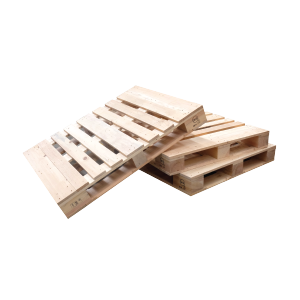
Wooden pallets still have their own advantages for applications that require heavy-duty construction and repeated use under demanding conditions. However, comparing paper and wooden pallets based solely on their materials is also not entirely appropriate.
Wooden pallet capacity varies depending on the type of wood, design, dimensions, number of stringers or blocks, and deck construction. The same principle applies to paper pallets.
A more relevant comparison is to consider capacity relative to pallet weight, intended use, and operating conditions. In certain applications, paper pallets can offer advantages in terms of weight, particularly when the main objective is to reduce packaging weight without compromising the required strength.
Also read “Wooden Pallet Load Capacity”
Environmental Conditions Affect Actual Capacity
Environmental conditions can also affect the performance of paper-based materials. Exposure to high humidity, water, temperature fluctuations, or certain storage conditions can affect the characteristics of the material and pallet structure.
Therefore, capacity achieved under laboratory conditions cannot always be directly applied to different field conditions. Suppliers need to understand how the pallet will be stored, how long it will be used, and what type of environment it will be exposed to.
Industries Suitable for High-Capacity Paper Pallets
Paper pallets with constructions designed for higher loads can be considered for various consumer goods applications. Products with medium to high unit loads can use paper pallets as long as the pallet specifications are properly matched to the load weight and handling method.
Export requirements are another interesting application. The lighter weight of paper pallets can help reduce the total shipment weight, particularly when companies ship goods in large volumes.
In addition, paper pallets can be used for single-use applications that still require specific load safety standards. Single-use does not mean that load capacity can be disregarded.
On the contrary, when a pallet is used only once for a specific shipment, its design must still ensure that the goods can be handled safely from the point of production to the final destination.
How to Verify Load Capacity Claims Before Ordering
Buyers should not make decisions based solely on capacity figures listed in catalogs or marketing materials. Ask for test data and make sure the testing conditions are clearly explained.
Ask whether the stated capacity refers to static, dynamic, or racking load capacity. Also ask how the load was distributed during testing and whether the testing conditions are representative of how the pallet will actually be used in the field.
Test data becomes much more useful when it is related to the actual requirements. For example, if a pallet will carry an 800 kg load and be moved by forklift several times a day, a test that only demonstrates its ability to withstand a static load is not sufficient as the sole basis for making a decision.
For large-volume requirements, conduct a small-scale trial before placing a bulk order. Samples can be used to evaluate pallet performance during loading, handling, storage, and transportation.
If necessary, companies can also establish testing parameters together with the supplier before the product is manufactured in large quantities. This approach helps reduce risks when pallets will be used under specific operating conditions.
Also read “Custom-Size Paper Pallets”
Strong Paper Pallets Must Be Supported by Data
Modern paper pallets are not automatically fragile simply because their base material is paper. With the right design and construction, paper pallets can be engineered to handle higher load requirements than commonly assumed.
However, there is no single capacity figure that applies to all types of paper pallets. Actual performance is always influenced by the material, design, load distribution, handling method, storage conditions, and operating environment.
Therefore, test data should be the primary basis for evaluating paper pallets for heavy loads, rather than simply relying on claims that a pallet has a high load capacity. Buyers need to ensure that the testing conditions correspond to the actual conditions of use.
If you are evaluating high-load-capacity paper pallets, BMR can help discuss your load requirements, handling methods, and operating conditions to determine the appropriate pallet specifications.
E-mail: info@bmr-pallets.com
WhatsApp: +62 817-200-135

