
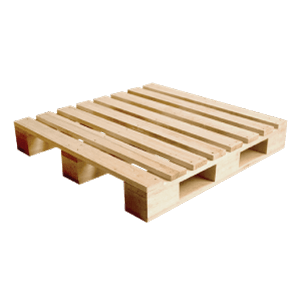



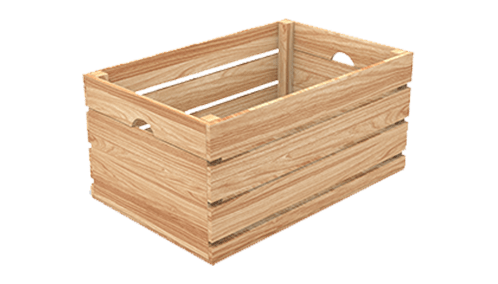
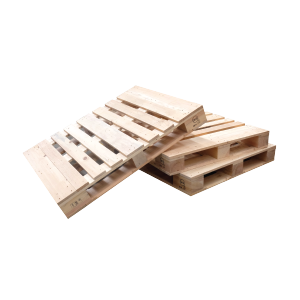

ISPM 15 is the international rule that wooden pallets, crates and other wood packaging must be debarked, treated against pests (usually by heat treatment at 56 °C core temperature for 30 minutes) and stamped with the IPPC mark before they cross a border. Pallets that meet it are called ISPM 15 pallets, and they can be shipped to any country that enforces the standard.
Most major trading countries enforce ISPM 15 on imports, including the European Union, the United Kingdom, the United States, Canada, China, Japan, South Korea, India, Australia and New Zealand. For practical purposes, any exporter shipping goods on solid wood pallets should assume the pallets must be ISPM 15 compliant.
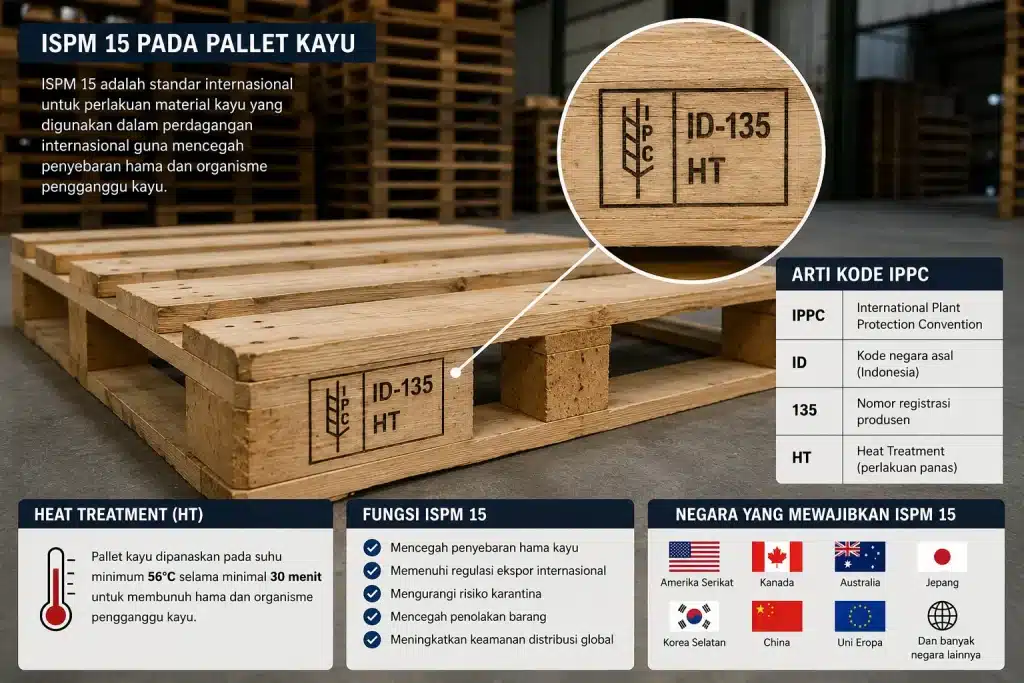
What ISPM 15 Means
ISPM 15 stands for International Standard for Phytosanitary Measures No. 15, titled “Regulation of wood packaging material in international trade”. It is published by the International Plant Protection Convention (IPPC), part of the UN Food and Agriculture Organization, and was first adopted in 2002.
Raw wood can carry wood-boring beetles, larvae and nematodes that survive long sea voyages and damage forests in the destination country. ISPM 15 reduces that risk by requiring every piece of solid wood packaging thicker than 6 mm, including pallets, wooden crates, skids and dunnage, to be:
- made from debarked wood,
- treated with an approved method by a registered treatment provider, and
- marked with the official IPPC stamp showing the country, provider number and treatment code.
ISPM 15 Countries: Who Requires It?
The IPPC has more than 180 member countries, and most of the world’s large importers check wood packaging at the border. The table lists well-known countries that enforce ISPM 15 on imported wood packaging. It is a guide, not an official register.
| Region | Examples of countries enforcing ISPM 15 |
|---|---|
| Europe | All 27 EU member states, United Kingdom, Norway, Switzerland, Turkey |
| North America | United States, Canada, Mexico |
| Latin America | Brazil, Chile, Argentina |
| Asia | China, Japan, South Korea, India, Indonesia, Philippines, Vietnam, Taiwan |
| Oceania | Australia, New Zealand |
| Africa | South Africa, Egypt |
There is no single official “ISPM 15 countries list” for 2026. Each country publishes its own import rules, and they change. Some add extra conditions, while the United States and Canada exempt wood packaging made in either country when it moves between the two. Before shipping, check the destination’s current rules, ask your buyer or forwarder, and see our ISPM 15 requirements by country guide.
What If the Destination Does Not Enforce ISPM 15?
Use ISPM 15 pallets anyway in most cases. Containers are often transshipped through ports in countries that do inspect, buyers frequently require treated pallets in their purchase terms, and pallets are reused for onward shipments. The extra treatment step is far cheaper than a rejected container.
Approved ISPM 15 Treatments
ISPM 15 recognises a small set of treatments, each with its own code on the stamp. In every case the wood must be debarked before treatment.
| Code | Treatment | Requirement |
|---|---|---|
| HT | Heat treatment | At least 56 °C at the wood core for 30 continuous minutes |
| DH | Dielectric heating | At least 60 °C through the whole profile for 1 continuous minute |
| MB | Methyl bromide fumigation | Gas fumigation; ozone-depleting, restricted in many countries |
| SF | Sulfuryl fluoride fumigation | Gas fumigation; less widely used |
HT is by far the most common treatment, and several countries and many buyers no longer accept methyl bromide. For a detailed comparison see HT vs fumigation pallets. To read the codes on a stamp, see what the IPPC stamp on a pallet means.
Materials Exempt from ISPM 15
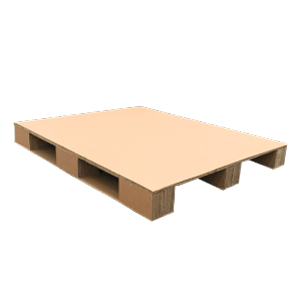
Some materials are exempt because processing already removes the pest risk: plywood, particleboard, OSB and other processed wood made with glue, heat or pressure, plus pieces of wood 6 mm thick or less, sawdust and wood wool. Non-wood pallets such as paper and plastic are not covered at all. That is why plywood pallets can be shipped without an IPPC stamp. Always confirm with your buyer, because some importers still ask for treated pallets.
ISPM 15 Pallets vs Regular Wooden Pallets
| ISPM 15 pallet | Regular (untreated) pallet | |
|---|---|---|
| Treatment | Debarked wood, heat treated (HT) or fumigated (MB) by a registered provider | No official treatment |
| Marking | IPPC stamp with country code, registration number and treatment code | No IPPC stamp |
| Use | International shipments and import/export | Domestic storage and distribution only |
| Border risk | Accepted by countries that enforce ISPM 15 | Can be rejected, quarantined, treated or destroyed at the destination port |
ISPM 15 says nothing about pallet size, strength or wood species. Any pallet dimension can be ISPM 15 compliant, so choose the size for your product, container and customer’s warehouse, then make sure it is treated and marked.
How Exporters Get ISPM 15 Compliant Pallets
- Check the destination’s rules and any extra requirements from your buyer.
- Buy from a registered treatment provider. Only facilities registered with the national plant protection organisation may apply the IPPC mark. In Indonesia, registration is issued by the Indonesian Quarantine Agency (Badan Karantina Indonesia).
- Make sure the pallets are treated and stamped before loading, with the mark legible on at least two opposite sides.
- Check repaired pallets. Any new boards must also be treated and marked.
- Keep the treatment records and declare the wood packaging on your shipping documents when the importer or forwarder asks for it.
BMR Pallets is a registered ISPM 15 heat-treatment provider with IPPC registration numbers 112 and 135, so pallets from our factories carry stamps such as ID-112 HT or ID-135 HT.
Frequently Asked Questions
What does ISPM 15 mean on a pallet?
It means the pallet is made from debarked wood that was treated against pests by a registered provider and marked with the IPPC stamp, so it can be used for international shipments.
Which countries require ISPM 15 pallets?
Most major importers do, including the EU, UK, US, Canada, Mexico, China, Japan, South Korea, India, Australia and New Zealand. Requirements change, so always check the destination’s current rules before shipping.
Do plywood pallets need ISPM 15 treatment?
No. Plywood, OSB and other processed wood products are exempt from ISPM 15, so plywood pallets do not need heat treatment or an IPPC stamp.
How long does ISPM 15 treatment last?
ISPM 15 sets no expiry date for treated pallets. The treatment stays valid as long as the pallet is not repaired or rebuilt with untreated wood, although some buyers set their own age limits.
Where can I buy ISPM 15 pallets in Indonesia?
From any producer registered with Badan Karantina Indonesia. BMR Pallets is registered under IDs 112 (Karawang) and 135 (Gresik) and supplies heat-treated export pallets and crates.
ISPM 15 Pallets from BMR
Since 2009 BMR Pallets has produced export pallets in Karawang, Gresik and Boyolali, with six heat-treatment chambers at our Karawang head office. We supply ISPM 15 heat-treated wooden pallets in custom sizes, EPAL Euro pallets and wooden crates, all made from SVLK legal timber. Request a quote or contact us on WhatsApp at +62 818-600-135 or info@bmr-pallets.com.

